 Hyperliquid
 order books, margin accounts and EVM applications
Hyperliquid combines onchain spot and perpetual trading with Ethereum-compatible applications on a single Layer 1 blockchain. Its native trading engine, HyperCore, handles order books and account balances, while HyperEVM runs smart contracts. Spot trades exchange token holdings; perpetuals create margined price exposure. Access can begin through a connected wallet or email login, with supported deposits supplying trading balances. Account mode determines how those balances support positions and which assets count as collateral.
· last updated
Bottom line: On Hyperliquid, spot trading and cross-margin positions can draw on the same asset balance when a unified account is active.
Spot holdings and perpetual exposure
Spot orders exchange token balances, while perpetual orders open or adjust derivative positions against collateral. A spot purchase provides a balance of the traded token. A perpetual position tracks price exposure without delivering that underlying token. Long positions gain from rising prices and short positions gain from falling prices, before trading costs and funding. Position size determines exposure; the collateral supporting it determines the account's capacity to absorb losses.
Core crypto perpetuals have no scheduled expiry. They use funding payments to help keep contract prices near their underlying reference prices. Builder-operated markets can have their own settlement arrangements. Buying a token, opening a derivative position and depositing into a strategy therefore create different holdings, even when one trading interface displays them together.
What must be ready before an order can execute?
An executable order needs an authorized signing method and enough available balance or margin for the selected market. Wallet connection supplies access to signing, while a supported deposit supplies funds. Money visible on another network or in an EVM wallet may not satisfy a HyperCore order.
- Confirm that the account has the required spendable balance or eligible collateral. Wait if a needed deposit has not credited it.
- Check the market's minimum order value, price and size precision, permitted margin mode and any applicable borrowing limit. Orders below the applicable minimum are rejected.
- Submit after those requirements are met. A signature authorizes the request; the order response establishes acceptance or rejection.
- Read fills and remaining open orders. Fills establish executed size and price; a resting remainder can wait or be canceled.
- Stop after a rejection and resolve its reported cause before resubmitting. After execution, manage the actual position or token balance.
HyperCore and HyperEVM within one chain
HyperCore and HyperEVM share HyperBFT consensus, but they perform different work within the blockchain. The trading engine records orders, cancellations, trades and liquidations onchain. Its clearinghouses maintain spot balances and perpetual margin state. HyperEVM provides the Ethereum Virtual Machine environment for general smart contracts, allowing application developers to combine programmable logic with the native trading infrastructure.
Shared consensus leaves distinct account states and execution rules for native trading and smart-contract applications.
Deposits that supply trading balances
USDC is natively minted on the blockchain, and Circle's Cross-Chain Transfer Protocol, or CCTP, supports transfers into HyperCore. The Arbitrum USDC deposit path is one entry option alongside transfers from other supported chains and compatible services. Supported deposits of other assets can credit spot balances that may need conversion into the selected market's quote or collateral asset. Portfolio margin provides a separate borrowing route against eligible collateral, subject to its access requirements and caps.
Account modes and the collateral at risk
Account mode determines which balances support trading, while a position's margin mode determines how collateral backs that position. A wallet login does not establish either setting, and changing balance organization can change which positions share exposure.
Balance organization
Standard and unified accounts
Standard mode keeps spot and perpetual balances separate across decentralized exchanges (DEXs), with cross margin confined to each DEX. Unified accounts use one balance per asset for spot trading and cross positions collateralized in that asset. Markets using the same collateral share that balance across DEXs. This arrangement does not automatically treat every token as collateral for every market.
Portfolio margin
Portfolio margin combines eligible spot assets and cross perpetual positions within an account. It can automatically borrow a required asset against eligible collateral when the available balance is insufficient. Account-value or weighted-volume requirements govern access, while collateral valuation rules and supply and borrowing caps constrain borrowing. Borrowed assets accrue interest, while idle supplied borrowable assets earn interest from borrowers. When a borrowing cap prevents further borrowing, additional margin must come from the settlement asset. Subaccounts remain separate, and the portfolio's maintenance requirement governs liquidation risk.
Cross and isolated positions
Cross margin shares collateral among positions within the account mode's applicable scope. Losses on one position can affect that shared margin. Isolated margin assigns collateral to a particular position and separates its liquidation exposure from other positions. Some markets require isolated margin. A strict-isolated market also prevents removing margin directly; closing exposure releases it proportionally.
Initial margin governs opening exposure, while maintenance margin governs whether existing exposure can remain open. Maximum leverage and margin tiers vary by market and position size. Lower leverage uses more initial collateral for the same exposure. For cross positions, account equity and other positions also affect liquidation risk, so the leverage setting alone cannot describe the remaining margin buffer.
EVM applications and linked token balances
HyperEVM transactions incur gas costs separately from native trading fees. HYPE is the native gas token on HyperEVM.
Contracts can support lending or other financial applications and send supported HyperCore actions through CoreWriter. Order actions sent this way enter an onchain delay before execution, so an enqueuing record has a different meaning from a trade fill. Transfers between Core spot tokens and their EVM representations require an established token link. HYPE uses its native EVM balance; linked fungible tokens use ERC-20 contracts. A link does not certify the contract's implementation or available token supply. Contract permissions and transfer behavior remain relevant even though both execution environments share consensus.
Execution controls for price and position size
A limit order constrains execution price, while a market order seeks immediate execution against available liquidity. HyperCore matches spot and perpetual orders using price-time priority. Order size must fit the market's lot size and price must fit its tick rules. A large requested size can encounter multiple price levels, making order-book depth relevant to slippage.
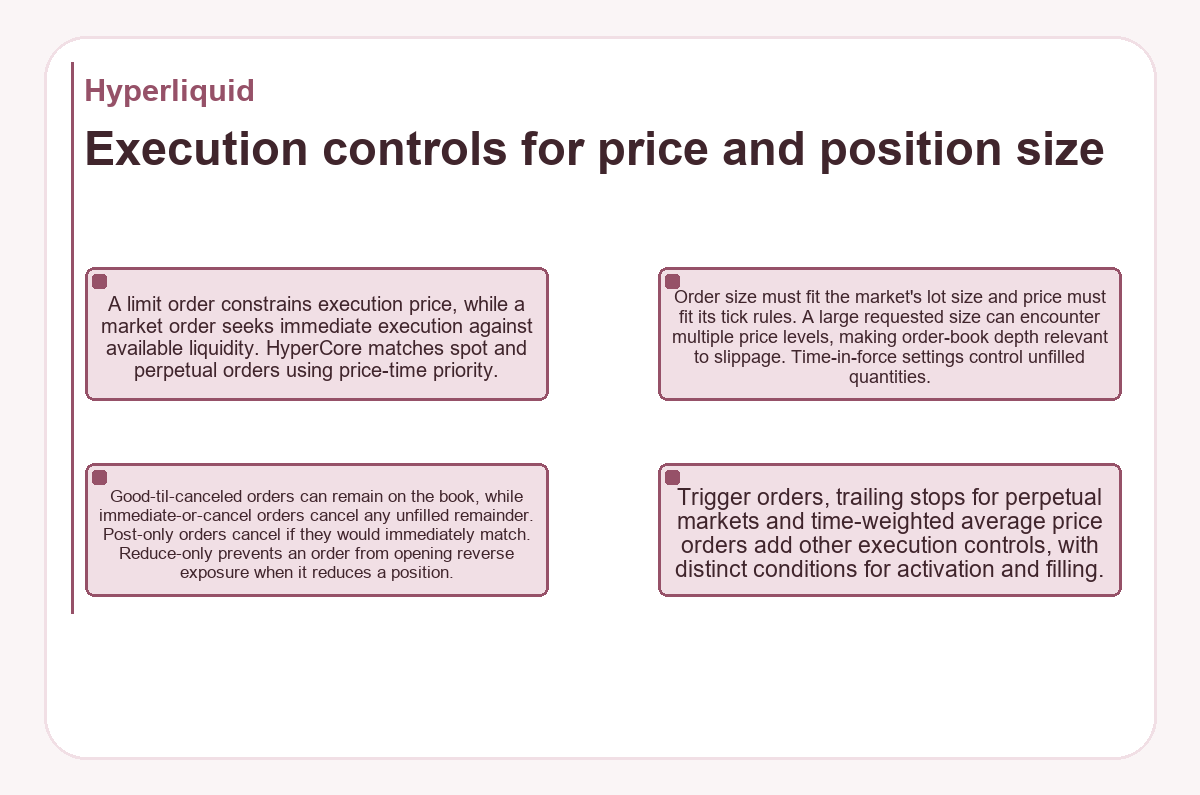
Time-in-force settings control unfilled quantities. Good-til-canceled orders can remain on the book, while immediate-or-cancel orders cancel any unfilled remainder. Post-only orders cancel if they would immediately match. Reduce-only prevents an order from opening reverse exposure when it reduces a position. Trigger orders, trailing stops for perpetual markets and time-weighted average price orders add other execution controls, with distinct conditions for activation and filling.
Trading fees, funding and borrowing costs
Execution costs depend on the market, account fee tier and whether a fill adds or removes liquidity. Spot and perpetual markets use different fee schedules but share a tier determined by rolling 14-day weighted volume, which counts spot volume twice. Staking discounts and market-specific fee settings can alter the effective charge, so one advertised rate cannot describe every trade.
Funding transfers value between long and short perpetual holders and occurs hourly. Its changing rate determines which side pays. Portfolio borrowing introduces interest separately from funding. Interfaces using approved builder codes can collect an additional fee on eligible fills, within the maximum that the user authorized. Source-network gas, transfer services and withdrawal methods can add costs outside the trading fee.
Token deployment, builder markets and outcomes
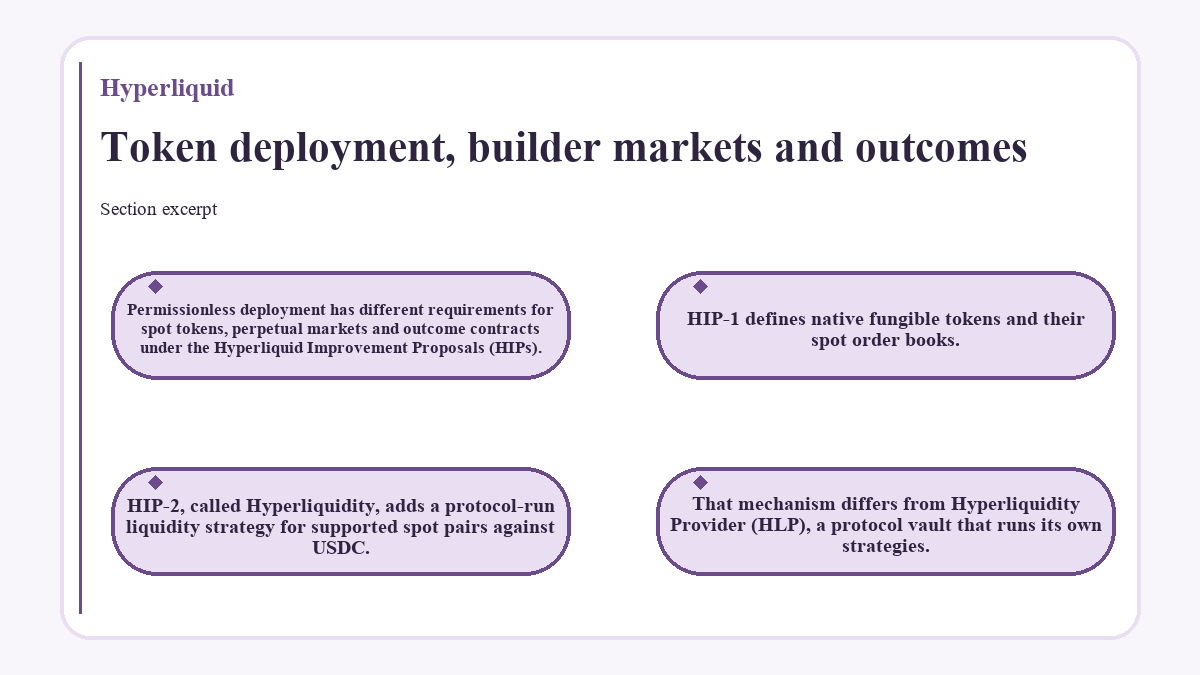
Permissionless deployment has different requirements for spot tokens, perpetual markets and outcome contracts under the Hyperliquid Improvement Proposals (HIPs). HIP-1 defines native fungible tokens and their spot order books. HIP-2, called Hyperliquidity, adds a protocol-run liquidity strategy for supported spot pairs against USDC. That mechanism differs from Hyperliquidity Provider (HLP), a protocol vault that runs its own strategies.
HIP-3 enables builder-deployed perpetual markets. The deployer defines contract specifications and the oracle, supplies oracle updates and sets leverage limits. Deployment requires staked HYPE, and validators can slash stake for irregular operations that threaten the protocol. A builder market therefore brings market-specific oracle and settlement dependencies alongside the shared trading engine. Slashed stake is burned instead of being distributed to affected traders.
HIP-4 defines fully collateralized outcome contracts that settle within a fixed range, including prediction-market and bounded derivatives applications. They have dated settlement and do not use leveraged perpetual liquidation mechanics. Protocol-deployed recurring outcomes encode their underlying reference and settlement conditions in the contract description. Permissionless outcome deployment is available on mainnet using validator-approved templates, subject to deployer staking requirements and deployment limits.
HYPE staking and HLP strategy exposure
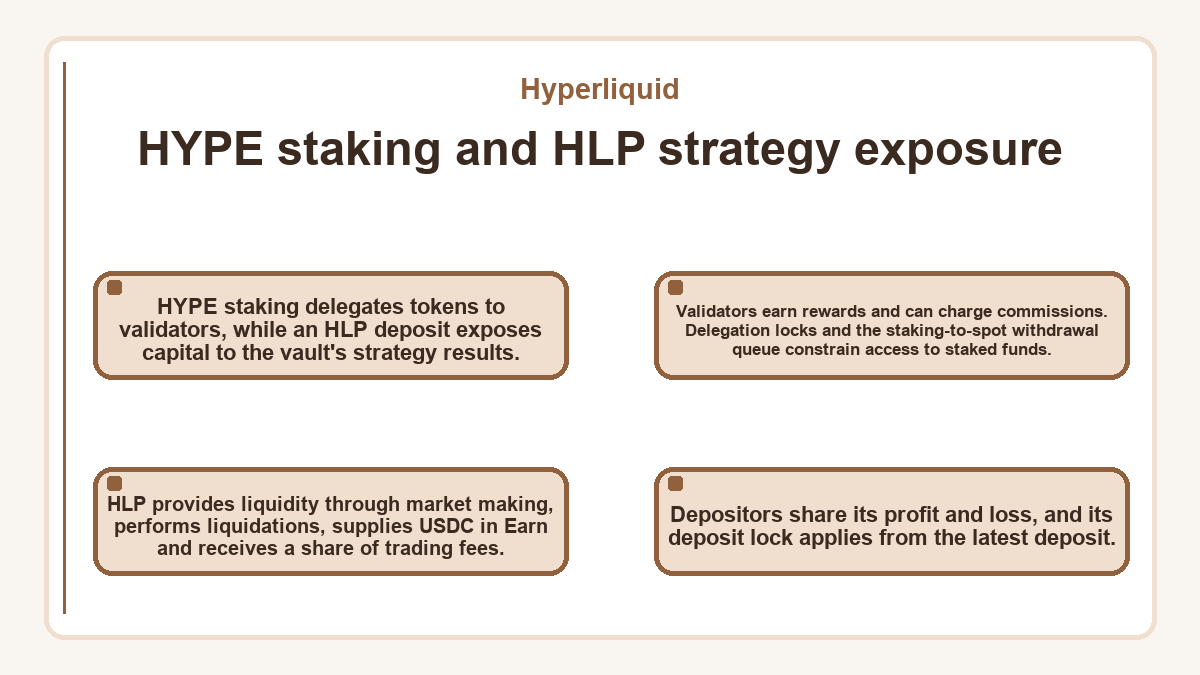
HYPE staking delegates tokens to validators, while an HLP deposit exposes capital to the vault's strategy results. Validators earn rewards and can charge commissions. Delegation locks and the staking-to-spot withdrawal queue constrain access to staked funds. HLP provides liquidity through market making, performs liquidations, supplies USDC in Earn and receives a share of trading fees. Depositors share its profit and loss, and its deposit lock applies from the latest deposit.
Account signing, APIs and public records
Trading interfaces support wallet connection or email-based access, while approved API wallets sign automated trading actions for a master account or its subaccounts. Supported actions and account permissions determine what a signing key can do. Orders and trades recorded onchain create publicly inspectable account histories, so wallet addresses do not provide transaction privacy. A separate approved trading key allows automation without copying the master wallet's private key into the trading process. API rate limits constrain automation, while daily account-action caps depend on account mode.
Oracle prices, mark prices and settlement assets
An oracle price supplies a reference for the underlying asset, while the mark price supports margin calculations and liquidation logic. The last traded price records an actual execution. These values serve different purposes and can diverge during volatility. A liquidation estimate can also change with funding or changes in other cross positions. Perpetual backstop liquidation transfers positions and supporting margin to a liquidator; isolated margin limits that transfer to the affected position and its margin.
Underwater accounts or isolated positions can trigger auto-deleveraging, which closes selected opposing positions to preserve protocol solvency.
The quote asset prices a spot market; the settlement or collateral asset governs a derivative's account obligations. Spot ownership fits a need to hold a transferable token. Perpetuals fit directional price exposure with margin and funding. A native order book offers explicit resting orders and execution controls, while a lending application adds its own contract and collateral rules. For an external withdrawal, destination support must cover the specific network and token representation, including whether the service supports HyperCore or HyperEVM.
Hyperliquid: what people ask
Will a limit order always qualify for a maker fee?
A limit order can pay a taker fee when it immediately matches resting liquidity. The limit controls the worst permitted execution price, while maker or taker status describes the fill's liquidity role. Any quantity that rests and later fills can have a different fee treatment. Post-only prevents immediate matching.
Can a TWAP order finish with part of its size unfilled?
A time-weighted average price order can reach its scheduled end without executing the full requested size. Its smaller suborders face slippage constraints and available liquidity. Later suborders can attempt to catch up, subject to size limits, but insufficient fills can leave an unfinished quantity when the schedule ends.
Why does querying an API wallet return no trading balance?
An API wallet signs actions, while trading balances belong to the master account or subaccount that it represents. Account-data queries need that trading account's address. Querying the signing agent's address can therefore return an empty result even when the intended account has funds or positions.
What happens to attached stop orders after I cancel a partially filled parent order?
Manually canceling a partially filled parent order also cancels its attached take-profit and stop-loss orders. That cancellation does not reverse the filled quantity or automatically close the resulting position. A different rule applies when insufficient margin cancels the partially filled parent: its attached orders are placed as though the parent fully filled.
Is an email login tied to a wallet that can be exported?
The Hyperliquid web interface's email login uses a wallet whose private key can be exported through its settings. The key can then be imported into a compatible wallet extension. Exporting changes how the address can be controlled; it does not convert unsupported deposits into trading balances or change the account's margin mode.
Are spot-token names unique identifiers?
A native spot token's human-readable name does not have to be unique. Its onchain identity comes from the unique hash generated at deployment, with token and market metadata providing the corresponding identifiers. A matching display name alone cannot establish that two balances or contracts represent the same asset.
Why can a USDC-margined perpetual use a USDT price index?
Some native crypto perpetuals use USDT-denominated oracle prices while accepting USDC collateral. Their accounting applies no USDC-to-USDT exchange-rate conversion, so the resulting profit or loss settles numerically in USDC. Other contracts can use USDC-denominated prices or different collateral arrangements; the contract specification determines the applicable relationship.